Eingeweidesysteme
Colon ascendens
Ascending colon
- System
- Eingeweidesysteme
- Regionen
- Rumpf, Abdomen
- Teil von
- Colon
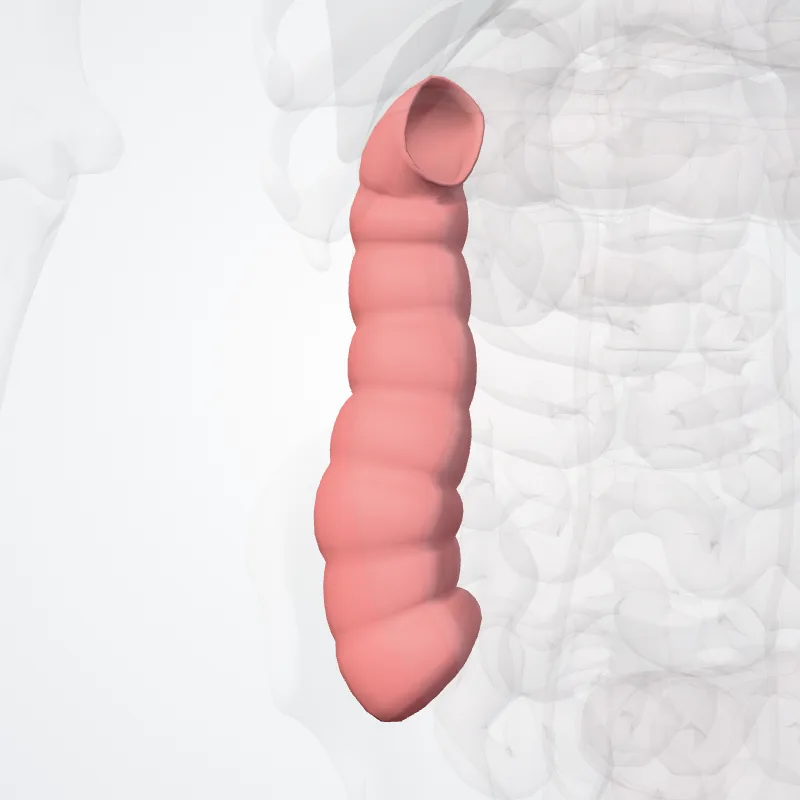
BeschreibungUngeprüft
Beschreibungen gibt es nur auf Englisch.
The large intestine, also known as the large bowel, is the last part of the gastrointestinal tract and of the digestive system in vertebrates.
Water is absorbed here and the remaining waste material is stored as feces before being removed by defecation.
The colon is the largest portion of the large intestine, so many mentions of the large intestine and colon overlap in meaning whenever precision is not the focus.
Most sources define the large intestine as the combination of the cecum, colon, rectum, and anal canal.
Some other sources exclude the anal canal.
In humans, the large intestine begins in the right iliac region of the pelvis, just at or below the waist, where it is joined to the end of the small intestine at the cecum, via the ileocecal valve.
It then continues as the colon ascending the abdomen, across the width of the abdominal cavity as the transverse colon, and then descending to the rectum and its endpoint at the anal canal.
Overall, in humans, the large intestine is about 1.5 metres (5 ft) long, which is about one-fifth of the whole length of the gastrointestinal tract.
Quelle: Wikipedia · Textlizenz: CC BY-SA 3.0 · Dieser Text stammt aus den Quelldaten und wurde noch nicht von einer Person geprüft.
Namen
- Latein
- Colon ascendens
- Englisch
- Ascending colon
- Französisch
- Côlon ascendant
- Spanisch
- Colon ascendente
- Portugiesisch
- Dois pontos ascendentes