BeschreibungUngeprüft
Beschreibungen gibt es nur auf Englisch.
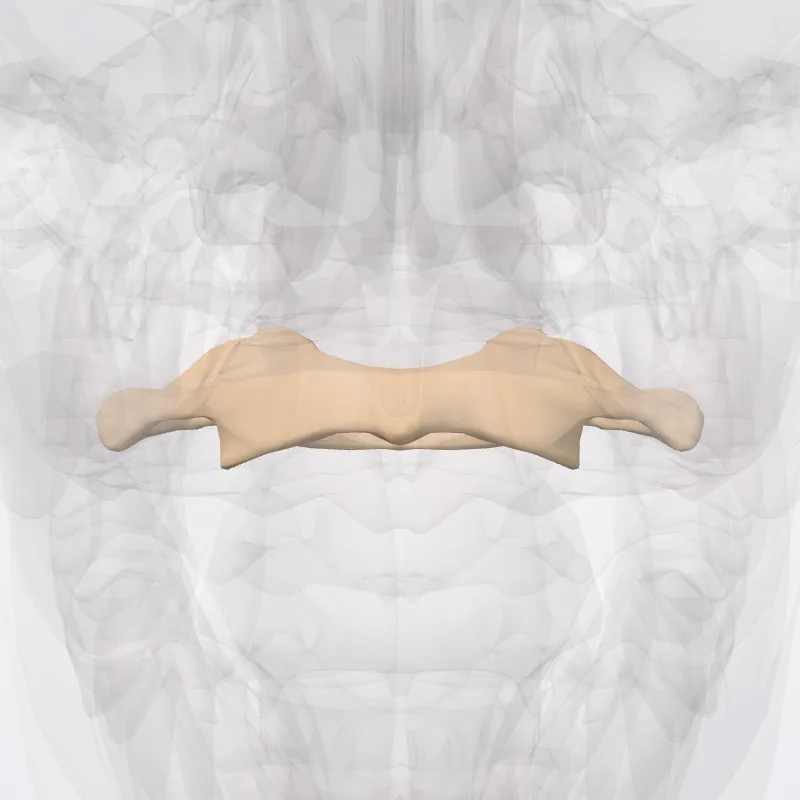
In anatomy, the atlas (C1) is the most superior (first) cervical vertebra of the spine and is located in the neck.
It is named for Atlas of Greek mythology because, just as Atlas supported the globe, it supports the entire head.
The atlas is the topmost vertebra and, with the axis (the vertebra below it), forms the joint connecting the skull and spine.
The atlas and axis are specialized to allow a greater range of motion than normal vertebrae.
They are responsible for the nodding and rotation movements of the head.
The atlanto-occipital joint allows the head to nod up and down on the vertebral column.
The dens acts as a pivot that allows the atlas and attached head to rotate on the axis, side to side.
The atlas's chief peculiarity is that it has no body.
It is ring-like and consists of an anterior and a posterior arch and two lateral masses.
The atlas and axis are important neurologically because the brainstem extends down to the axis.
Quelle: Wikipedia · Textlizenz: CC BY-SA 3.0 · Dieser Text stammt aus den Quelldaten und wurde noch nicht von einer Person geprüft.
Muskelursprünge und -ansätze
Hier entspringende Muskeln
Hier ansetzende Muskeln
Landmarken
- (Canalis arteriae vertebralis)
- Arcus anterior atlantis
- Arcus posterior atlantis
- Facies articularis inferior atlantis
- Facies articularis superior atlantis
- Fovea dentis
- Massa lateralis atlantis
- Sulcus arteriae vertebralis
- Tuberculum anterius atlantis
- Tuberculum ligamenti transversi
- Tuberculum posterius atlantis
Namen
- Latein
- Atlas (C1)
- Englisch
- Atlas (C1)
- Französisch
- Atlas (C1)
- Spanisch
- Atlas (C1)
- Portugiesisch
- Atlas (C1)