Landmarke · Skelettsystem
Fossa glenoidea
Glenoid fossa
- System
- Skelettsystem
- Regionen
- Rumpf, Obere Extremität
- Seite
- Links und rechts
- Landmarke auf
- Scapula
BeschreibungUngeprüft
Beschreibungen gibt es nur auf Englisch.
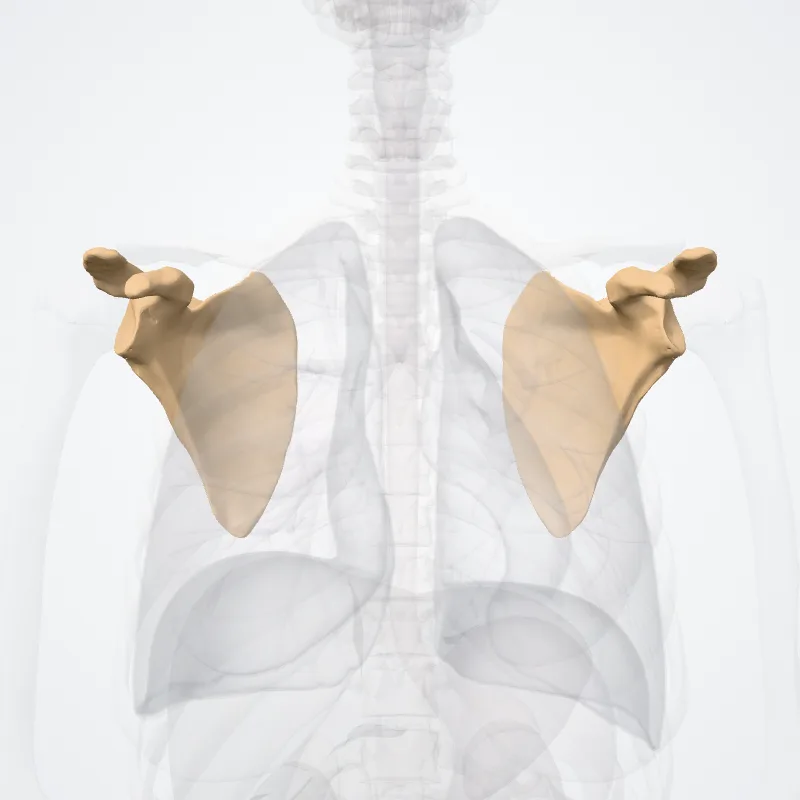
The glenoid fossa of the scapula or the glenoid cavity is a part of the shoulder.
It is a shallow, pyriform articular surface, which is located on the lateral angle of the scapula.
It is directed laterally and forward and articulates with the head of the humerus; it is broader below than above and its vertical diameter is the longest.
This cavity forms the glenohumeral joint along with the humerus. This type of joint is classified as a synovial, ball and socket joint.
The humerus is held in place within the glenoid cavity by means of the long head of the biceps tendon.
This tendon originates on the superior margin of the glenoid cavity and loops over the shoulder, bracing humerus against the cavity.
The rotator cuff also reinforces this joint more specifically with the supraspinatus tendon to hold the head of the humerus in the glenoid cavity.
The cavity surface is covered with cartilage in the fresh state, and its margins, slightly raised, give attachment to a fibrocartilaginous structure, the glenoid labrum, which deepens the cavity.
This cartilage is very susceptible to tearing. When torn, it is most commonly known as a SLAP lesion which is generally caused by repetitive shoulder movements.
Compared to the acetabulum (at the hip-joint) the glenoid cavity is relatively shallow. This makes the shoulder joint prone to dislocation (luxation).
Strong glenohumeral ligaments and muscles prevents dislocation in most cases.
By being so shallow the glenoid cavity allows the shoulder joint to have the greatest mobility of all joints in the body, allowing 120 degrees of unassisted flexion.
Quelle: Wikipedia · Textlizenz: CC BY-SA 3.0 · Dieser Text stammt aus den Quelldaten und wurde noch nicht von einer Person geprüft.
Namen
- Latein
- Fossa glenoidea
- Englisch
- Glenoid fossa
- Französisch
- Cavité glénoïde
- Spanisch
- Fosa glenoidea
- Portugiesisch
- Fossa glenóide