Gruppe · Muskelsystem
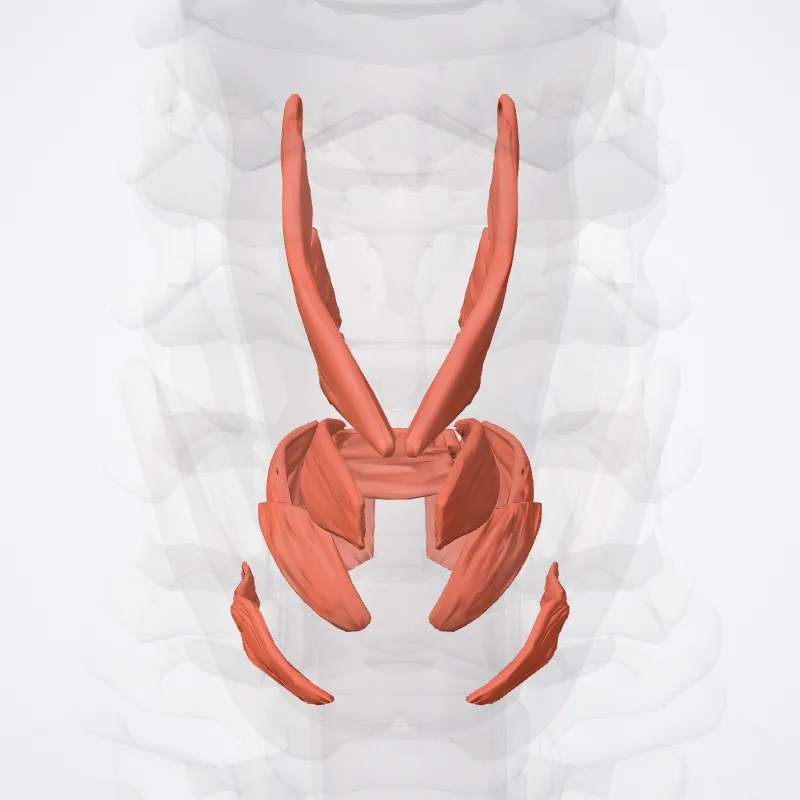
Musculi laryngis
Laryngeal muscles
- System
- Muskelsystem
- Regionen
- Hals, Rumpf
- Teil von
- Musculi colli
BeschreibungUngeprüft
Beschreibungen gibt es nur auf Englisch.
The muscles of the larynx are divided into intrinsic and extrinsic muscles.
The extrinsic muscles act on the region and pass between the larynx and parts around it but have their origin elsewhere; the intrinsic muscles are confined entirely within the larynx and have their origin and insertion there.
The intrinsic muscles are divided into respiratory and the phonatory muscles (the muscles of phonation).
The respiratory muscles move the vocal cords apart and serve breathing.
The phonatory muscles move the vocal cords together and serve the production of voice.
The main respiratory muscles are the posterior cricoarytenoid muscles.
The phonatory muscles are divided into adductors (lateral cricoarytenoid muscles, arytenoid muscles) and tensors (cricothyroid muscles, thyroarytenoid muscles).
Intrinsic
The intrinsic laryngeal muscles are responsible for controlling sound production.
- Cricothyroid muscle lengthen and tense the vocal cords.
- Posterior cricoarytenoid muscles abduct and externally rotate the arytenoid cartilages, resulting in abducted vocal cords.
- Lateral cricoarytenoid muscles adduct and internally rotate the arytenoid cartilages, increase medial compression.
- Transverse arytenoid muscle adduct the arytenoid cartilages, resulting in adducted vocal cords.
- Oblique arytenoid muscles narrow the laryngeal inlet by constricting the distance between the arytenoid cartilages.
- Thyroarytenoid muscles narrow the laryngeal inlet, shortening the vocal cords, and lowering voice pitch.
- The internal thyroarytenoid is the portion of the thyroarytenoid that vibrates to produce sound.
Notably the only muscle capable of separating the vocal cords for normal breathing is the posterior cricoarytenoid.
If this muscle is incapacitated on both sides, the inability to pull the vocal cords apart (abduct) will cause difficulty breathing.
Bilateral injury to the recurrent laryngeal nerve would cause this condition.
It is also worth noting that all muscles are innervated by the recurrent laryngeal branch of the vagus except the cricothyroid muscle, which is innervated by the external laryngeal branch of the superior laryngeal nerve (a branch of the vagus).
Additionally, intrinsic laryngeal muscles present a constitutive Ca2+-buffering profile that predicts their better ability to handle calcium changes in comparison to other muscles.
This profile is in agreement with their function as very fast muscles with a well-developed capacity for prolonged work.
Studies suggests that mechanisms involved in the prompt sequestering of Ca2+ (sarcoplasmic reticulum Ca2+-reuptake proteins, plasma membrane pumps, and cytosolic Ca2+-buffering proteins) are particularly elevated in laryngeal muscles, indicating their importance for the myofiber function and protection against disease, such as Duchenne muscular dystrophy.
Furthermore, different levels of Orai1 in rat intrinsic laryngeal muscles and extraocular muscles over the limb muscle suggests a role for store operated calcium entry channels in those muscles' functional properties and signaling mechanisms.
Extrinsic
The extrinsic laryngeal muscles support and position the larynx within the mid-cervical region. [trachea.]
Extrinsic laryngeal muscles
- Sternothyroid muscles depress the larynx. (Innervated by ansa cervicalis)
- Omohyoid muscles depress the larynx. (Ansa cervicalis)
- Sternohyoid muscles depress the larynx. (Ansa cervicalis)
- Inferior constrictor muscles. (CN X)
- Thyrohyoid muscles elevates the larynx. (C1)
- Digastric elevates the larynx. (CN V3, CN VII)
- Stylohyoid elevates the larynx. (CN VII)
- Mylohyoid elevates the larynx. (CN V3)
- Geniohyoid elevates the larynx. (C1)
- Hyoglossus elevates the larynx. (CN XII)
- Genioglossus elevates the larynx. (CN XII)
Quelle: Z-Anatomy · Textlizenz: CC BY-SA 4.0 · Dieser Text stammt aus den Quelldaten und wurde noch nicht von einer Person geprüft.
Bestandteile
- Musculus arytenoideus transversus
- Musculus cricoarytendoideus lateralis
- Musculus cricoarytenoideus posterior
- Pars aryepiglottica musculi arytenoidei obliqui
- Pars externa musculi thyreoarytenoidei
- Pars obliqua musculi cricothyreoidei
- Pars recta musculi cricothyreoidei
- Pars thyreoepiglottica musculi thyreoarytenoidei
Namen
- Latein
- Musculi laryngis
- Englisch
- Laryngeal muscles
- Französisch
- Muscles du larynx
- Spanisch
- Músculos laríngeos
- Portugiesisch
- Músculos laríngeos