Skelettsystem
Dens caninus inferioris
Lower canine
- System
- Skelettsystem
- Regionen
- Kopf
- Seite
- Links und rechts
- Teil von
- Dentes anteriores
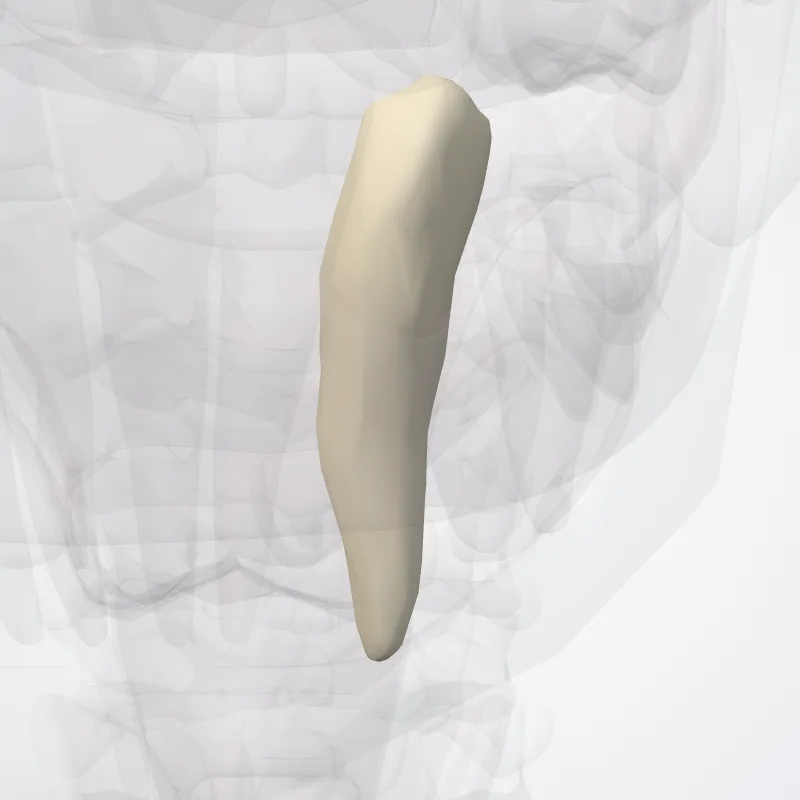
BeschreibungUngeprüft
Beschreibungen gibt es nur auf Englisch.
In mammalian oral anatomy, the canine teeth, also called cuspids, dog teeth, or (in the context of the upper jaw) fangs, eye teeth, vampire teeth, or vampire fangs, are the relatively long, pointed teeth.
They can appear more flattened however, causing them to resemble incisors and leading them to be called incisiform.
They developed and are used primarily for firmly holding food in order to tear it apart, and occasionally as weapons.
They are often the largest teeth in a mammal's mouth.
Individuals of most species that develop them normally have four, two in the upper jaw and two in the lower, separated within each jaw by incisors; humans and dogs are examples.
In most species, canines are the anterior-most teeth in the maxillary bone. The four canines in humans are the two maxillary canines and the two mandibular canines.
Quelle: Wikipedia · Textlizenz: CC BY-SA 3.0 · Dieser Text stammt aus den Quelldaten und wurde noch nicht von einer Person geprüft.
Namen
- Latein
- Dens caninus inferioris
- Englisch
- Lower canine
- Französisch
- Dent canine inférieure
- Spanisch
- Diente canino inferior
- Portugiesisch
- Canino inferior