Nervensystem und Sinnesorgane
Lunate sulcus
- System
- Nervensystem und Sinnesorgane
- Regionen
- Kopf
- Seite
- Links und rechts
- Teil von
- Lobus occipitalis
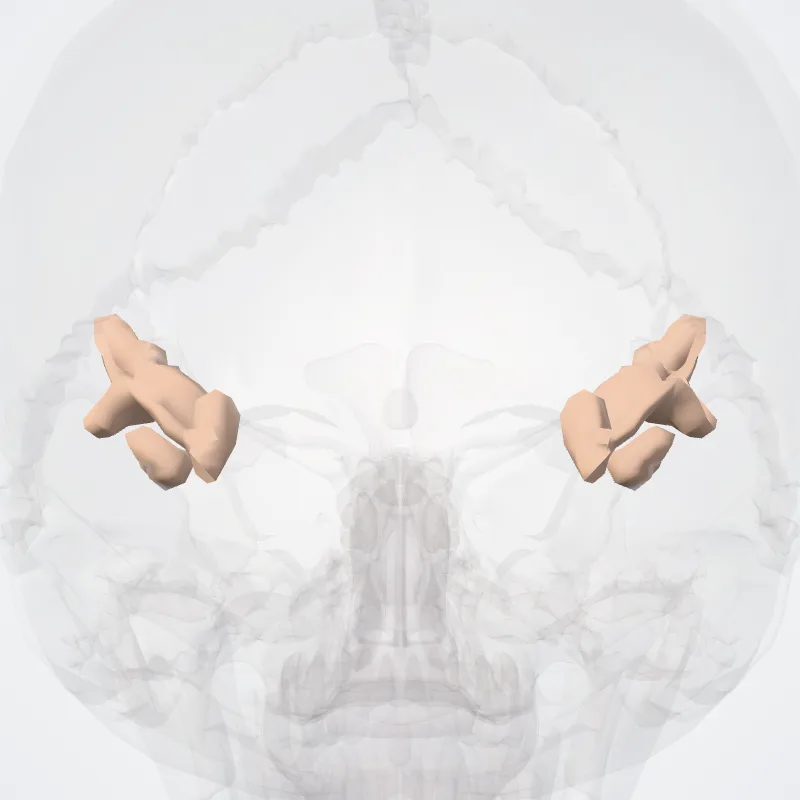
BeschreibungUngeprüft
Beschreibungen gibt es nur auf Englisch.
In brain anatomy, the lunate sulcus or simian sulcus also known as the sulcus lunatus is a fissure in the occipital lobe variably found in humans and more often larger when present in apes and monkeys.
The lunate sulcus marks the transition between V1 and V2.The lunate sulcus lies further back in human brains but has a more forward location in chimpanzees.
The evolutionary expansion of the frontal areas of the lunate sulcus would have caused a shift in the particular location of the fissure.
It has been hypothesized that evolutionary pressures resulted in the human brain undergoing internal reorganization to develop the capability of human language.
Furthermore, this reorganization must have been implemented during early maturity and is likely responsible for eidetic imagery in some adolescents.During early development, the neural connections in prefrontal cortex and posterior parietal lobe rapidly expand to allow capability for human language, while visual memory capacity of human brain would become limited.
Biological studies have demonstrated that the lunate sulcus is subject to white matter growth, and dental fossil and tomography studies have shown that the brain organization of Australopithecus africanus is pongid-like.
Quelle: Wikipedia · Textlizenz: CC BY-SA 3.0 · Dieser Text stammt aus den Quelldaten und wurde noch nicht von einer Person geprüft.
Namen
- Englisch
- Lunate sulcus