Gruppe · Muskelsystem
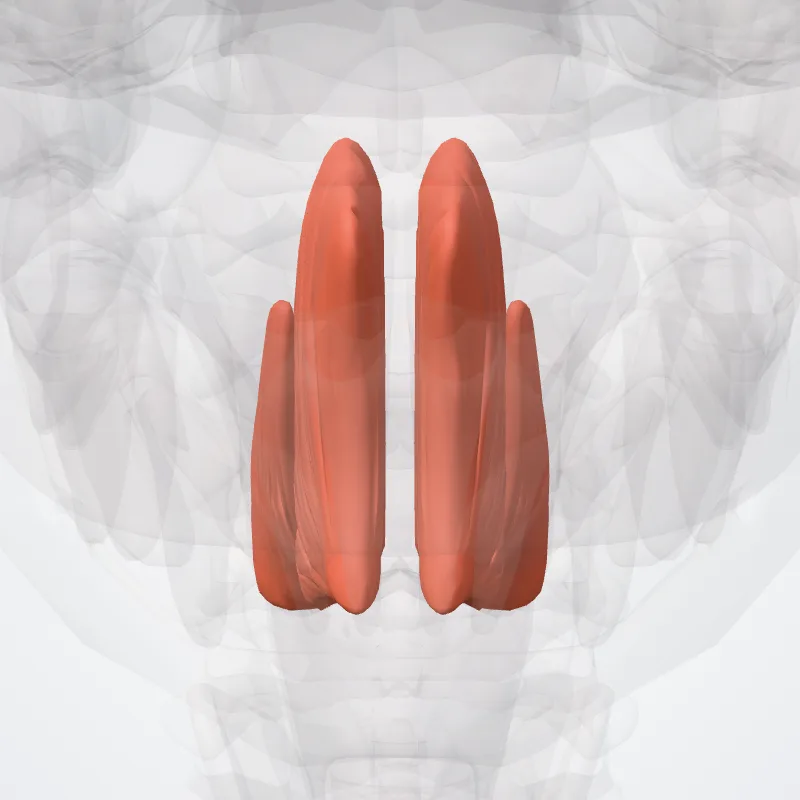
Musculi linguae
Muscles of tongue
- System
- Muskelsystem
- Regionen
- Kopf
- Teil von
- Muculi capitis
BeschreibungUngeprüft
Beschreibungen gibt es nur auf Englisch.
The eight muscles of the human tongue are classified as either intrinsic or extrinsic.
The four intrinsic muscles act to change the shape of the tongue, and are not attached to any bone.
The four extrinsic muscles act to change the position of the tongue, and are anchored to bone.
Extrinsic
Lateral view of the tongue, with extrinsic muscles highlighted
The four extrinsic muscles originate from bone and extend to the tongue.
They are the genioglossus, the hyoglossus (often including the chondroglossus) the styloglossus, and the palatoglossus.
Their main functions are altering the tongue's position allowing for protrusion, retraction, and side-to-side movement.
The genioglossus arises from the mandible and protrudes the tongue.
It is also known as the tongue's "safety muscle" since it is the only muscle that propels the tongue forward.
The hyoglossus, arises from the hyoid bone and retracts and depresses the tongue. The chondroglossus is often included with this muscle.
The styloglossus arises from the styloid process of the temporal bone and draws the sides of the tongue up to create a trough for swallowing.
The palatoglossus arises from the palatine aponeurosis, and depresses the soft palate, moves the palatoglossal fold towards the midline, and elevates the back of the tongue during swallowing.
Intrinsic
Coronal section of tongue, showing intrinsic muscles
Four paired intrinsic muscles of the tongue originate and insert within the tongue, running along its length.
They are the superior longitudinal muscle, the inferior longitudinal muscle, the vertical muscle, and the transverse muscle.
These muscles alter the shape of the tongue by lengthening and shortening it, curling and uncurling its apex and edges as in tongue rolling, and flattening and rounding its surface.
This provides shape and helps facilitate speech, swallowing, and eating.
The superior longitudinal muscle runs along the upper surface of the tongue under the mucous membrane, and elevates, assists in retraction of, or deviates the tip of the tongue.
It originates near the epiglottis, at the hyoid bone, from the median fibrous septum.
The inferior longitudinal muscle lines the sides of the tongue, and is joined to the styloglossus muscle.
The vertical muscle is located in the middle of the tongue, and joins the superior and inferior longitudinal muscles.
The transverse muscle divides the tongue at the middle, and is attached to the mucous membranes that run along the sides.
Quelle: Z-Anatomy · Textlizenz: CC BY-SA 4.0 · Dieser Text stammt aus den Quelldaten und wurde noch nicht von einer Person geprüft.
Bestandteile
Namen
- Latein
- Musculi linguae
- Englisch
- Muscles of tongue
- Französisch
- Muscles de la langue
- Spanisch
- Músculos de la lengua
- Portugiesisch
- Músculos da língua