BeschreibungUngeprüft
Beschreibungen gibt es nur auf Englisch.
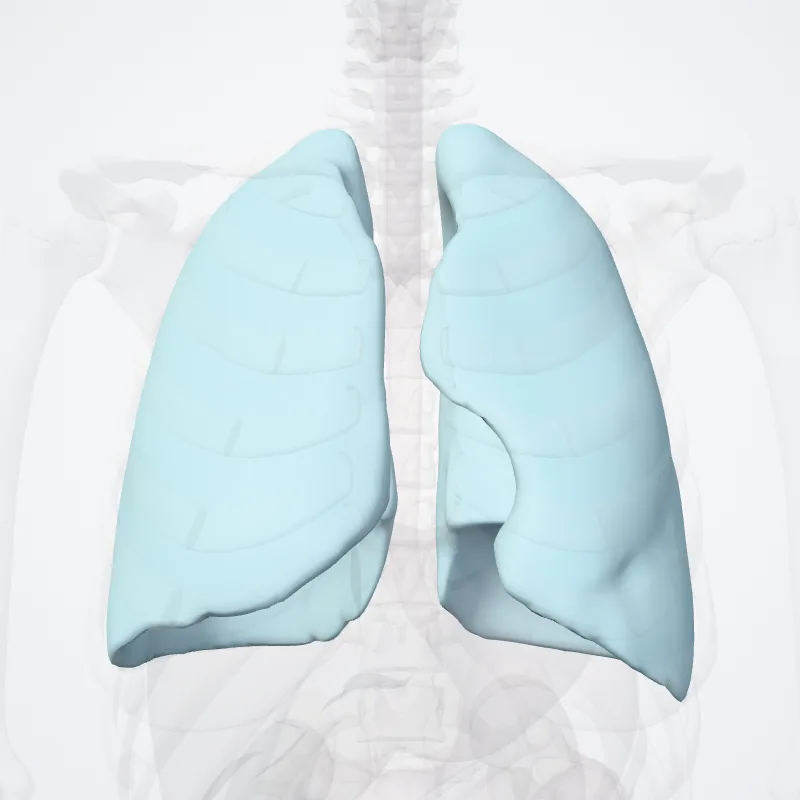
The pulmonary pleurae (sing. pleura) are the two opposing layers of serous membrane overlying the lungs and the inside of the surrounding chest walls.
The inner pleura, called the visceral pleura, covers the surface of each lung and dips between the lobes of the lung as fissures, and is formed by the invagination of lung buds into each thoracic sac during embryonic development.
The outer layer, called the parietal pleura, lines the inner surfaces of the thoracic cavity on each side of the mediastinum, and can be subdivided into mediastinal (covering the side surfaces of the fibrous pericardium, oesophagus and thoracic aorta), diaphragmatic (covering the upper surface of the diaphragm), costal (covering the inside of rib cage) and cervical (covering the underside of the suprapleural membrane) pleurae.
The visceral and the mediastinal parietal pleurae are connected at the root of the lung ("hilum") through a smooth fold known as pleural reflections, and a bell sleeve-like extension of visceral pleura hanging under to the hilum is known as the pulmonary ligament.
Between two pleurae is a potential space called the pleural cavity (also pleural space), which is normally collapsed and filled with only a tiny amount of serous fluid (pleural fluid) secreted by the pleurae, and is clinically considered vacuumous under healthy conditions.
The two lungs bounded by parietal pleura, almost fill the thoracic cavity.
Quelle: Wikipedia · Textlizenz: CC BY-SA 3.0 · Dieser Text stammt aus den Quelldaten und wurde noch nicht von einer Person geprüft.
Namen
- Latein
- Pleura
- Englisch
- Pleura
- Französisch
- Plèvre
- Spanisch
- Pleura
- Portugiesisch
- Pleura