Landmark · Visceral systems
Bare area of liver
Area nuda hepatis
- System
- Visceral systems
- Regions
- Trunk, Abdomen
- Landmark on
- Liver
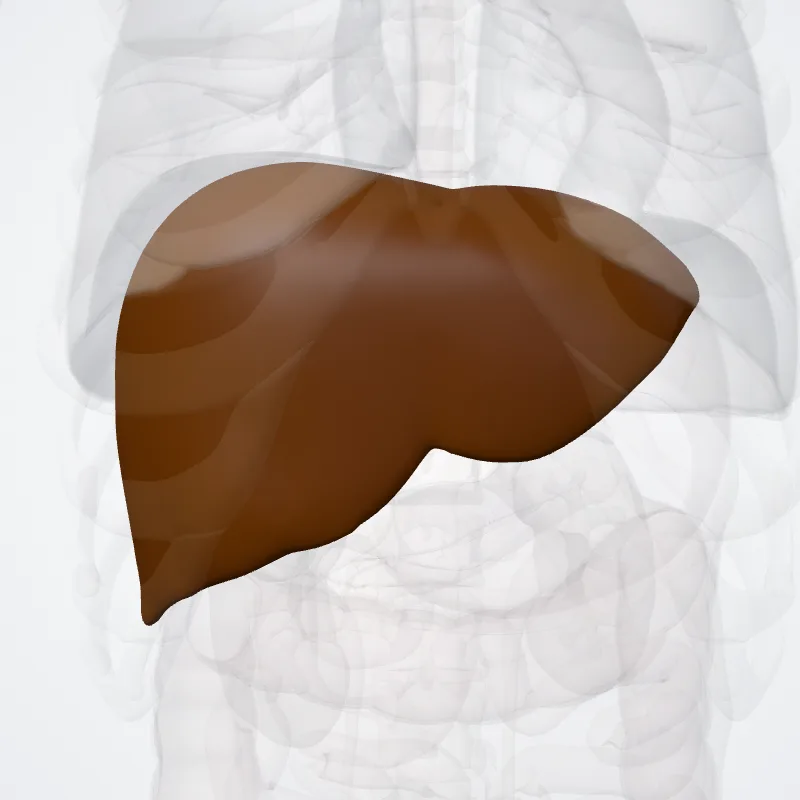
DescriptionUnreviewed
The bare area of the liver (nonperitoneal area) is a large triangular area on the diaphragmatic surface of the liver.
It is the only part of the liver with no peritoneal covering, although it is still covered by Glisson’s capsule.
It is attached directly to the diaphragm by loose connective tissue.
The bare area of the liver is relevant to the portacaval anastomosis, encloses the right extraperitoneal subphrenic space, and can be a site of spread of infection from the abdominal cavity to the thoracic cavity.
Structure
The bare area of the liver is found on the posterosuperior surface of the right lobe of the liver.
This lies close to the thoracic diaphragm.
It is the only part of the liver that has no peritoneal covering.
It lies between the two layers of the coronary ligament, as well as the right triangular ligament.
The coronary ligament represents reflections of the visceral peritoneum covering the liver onto the diaphragm.
The bare area of the liver is attached to the thoracic diaphragm by loose connective tissue.
It touches the bottom surface of the diaphragm.
It is also not covered in capsule.
Clinical significance
The bare area of the liver is clinically important because of the portacaval anastomosis.
It is a site where infection can spread from the abdominal cavity to the thoracic cavity.
It encloses the right extraperitoneal subphrenic space.
Source: Z-Anatomy · Text licence: CC BY-SA 4.0 · This text comes from the source data and has not been reviewed by a person yet.
Names
- Latin
- Area nuda hepatis
- English
- Bare area of liver
- French
- Area nuda
- Spanish
- Área desnuda del hígado
- Portuguese
- Área nua do fígado
In the same group
- Anterior lateral segment of liver (VI)
- Anterior medial segment of liver (V)
- Left anterior lateral segment of liver (III)
- Left medial segment of liver (IV)
- Left posterior lateral segment of liver (II)
- Posterior lateral segment of liver (VII)
- Posterior medial segment of liver (VIII)
- Posterior segment of liver (I)