Group · Joints & ligaments
Cranial syndesmoses
Syndesmoses cranii
- System
- Joints & ligaments
- Regions
- Head
- Part of
- Cranial fibrous joints
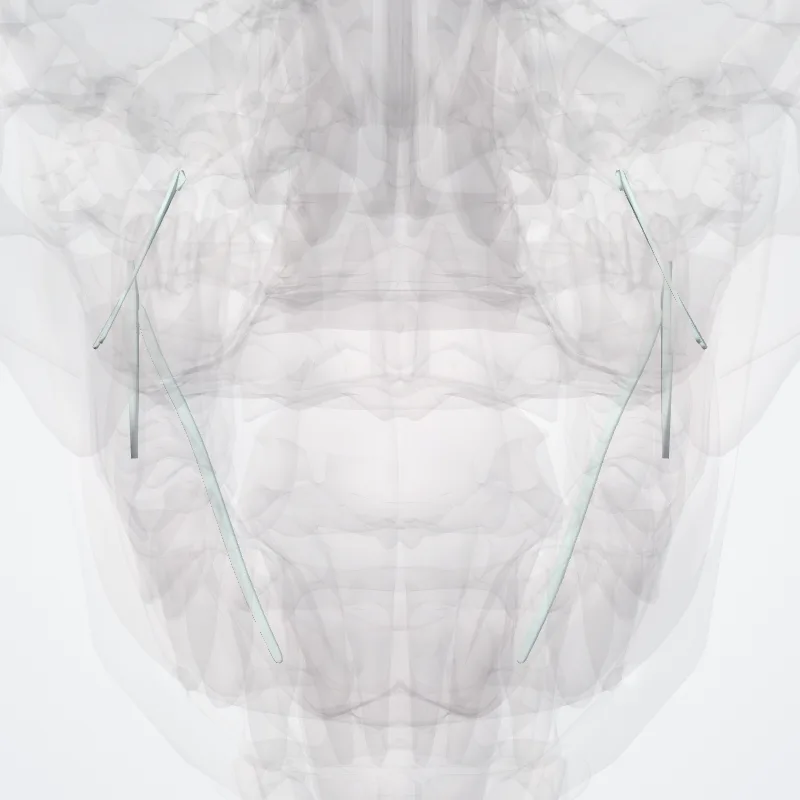
DescriptionUnreviewed
- Pterygospinous ligament
- Stylohyoid ligament
- Sphenomandibular ligament
- Stylomandibular ligament
- Ligaments of auricle
A syndesmosis is a non-movable fibrous joint in which bones such as the tibia and fibula are joined together by connective tissue.
An example is the distal tibiofibular joint.
Injuries to the ankle syndesmosis are commonly known as a "high ankle sprain".
Although the syndesmosis is a joint, in the literature the term syndesmotic injury is used to describe injury of the syndesmotic ligaments.
It comes from the Greek σύν, syn (meaning "with") and δεσμός, desmos (meaning "a band").
Syndesmosis sprains have received increasing recognition during recent years because of a heightened awareness of the mechanism, symptoms, and signs of injury.
Source: Z-Anatomy · Text licence: CC BY-SA 4.0 · This text comes from the source data and has not been reviewed by a person yet.
Parts
Names
- Latin
- Syndesmoses cranii
- English
- Cranial syndesmoses
- French
- Syndesmoses crâniennes
- Spanish
- Sindesmosis craneales
- Portuguese
- Sindesmoses cranianas