DescriptionUnreviewed
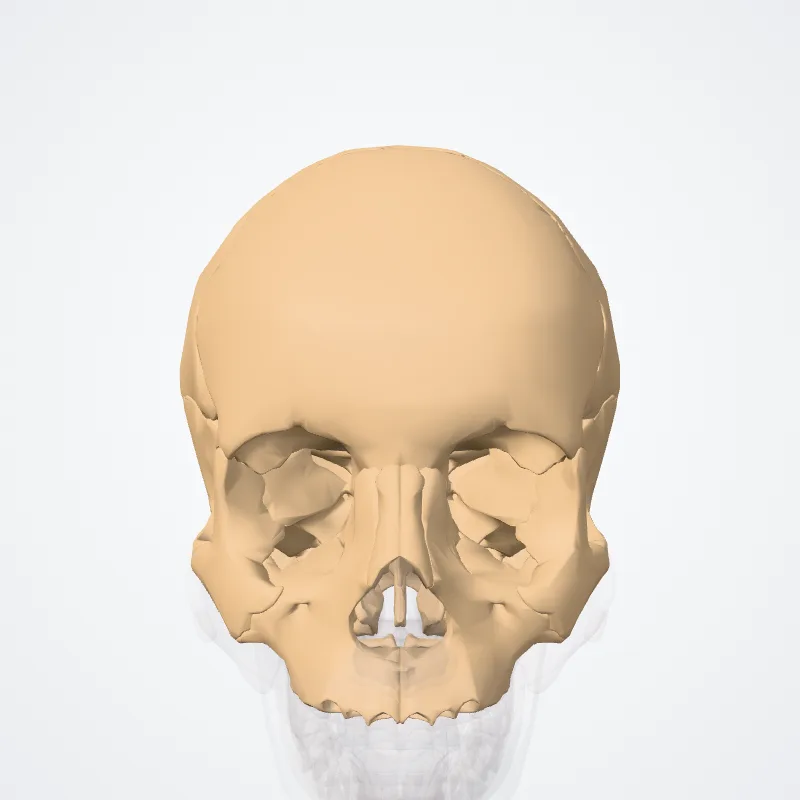
The human skull is the bony structure that forms the head in the human skeleton.
It supports the structures of the face and forms a cavity for the brain.
Like the skulls of other vertebrates, it protects the brain from injury.
The skull consists of three parts, of different embryological origin—the neurocranium, the sutures, and the facial skeleton (also called the membraneous viscerocranium).
The neurocranium (or braincase) forms the protective cranial cavity that surrounds and houses the brain and brainstem.
The upper areas of the cranial bones form the calvaria (skullcap). The membranous viscerocranium includes the mandible.
The sutures are fairly rigid joints between bones of the neurocranium.
The facial skeleton is formed by the bones supporting the face.
BONES
Except for the mandible, all of the bones of the skull are joined together by sutures—synarthrodial (immovable) joints formed by bony ossification, with Sharpey's fibres permitting some flexibility.
Sometimes there can be extra bone pieces within the suture known as wormian bones or sutural bones. Most commonly these are found in the course of the lambdoid suture.
The human skull is generally considered to consist of twenty-two bones—eight cranial bones and fourteen facial skeleton bones.
In the neurocranium these are the occipital bone, two temporal bones, two parietal bones, the sphenoid, ethmoid and frontal bones.
The bones of the facial skeleton (14) are
- the vomer,
- two inferior nasal conchae,
- two nasal bones,
- two maxilla,
- the mandible,
- two palatine bones,
- two zygomatic bones,
- and two lacrimal bones.
Continue reading on Wikipedia →
Source: Wikipedia · Text licence: CC BY-SA 3.0 · This text comes from the source data and has not been reviewed by a person yet.
Parts
Names
- Latin
- Cranium
- English
- Cranium
- French
- Crâne
- Spanish
- Cráneo
- Portuguese
- Crânio