Landmark · Visceral systems
Diaphragmatic surface of liver
Facies diaphragmatica hepatis
- System
- Visceral systems
- Regions
- Trunk, Abdomen
- Landmark on
- Liver
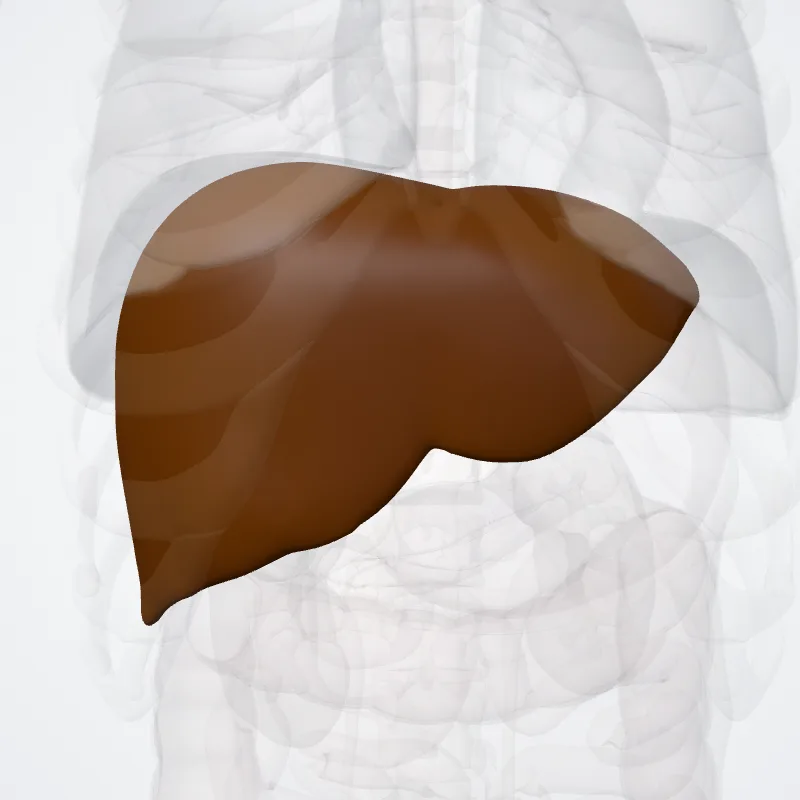
DescriptionUnreviewed
On the diaphragmatic surface, apart from a triangular bare area where it connects to the diaphragm, the liver is covered by a thin, double-layered membrane, the peritoneum, that helps to reduce friction against other organs.
This surface covers the convex shape of the two lobes where it accommodates the shape of the diaphragm.
The peritoneum folds back on itself to form the falciform ligament and the right and left triangular ligaments.
These peritoneal ligaments are not related to the anatomic ligaments in joints, and the right and left triangular ligaments have no known functional importance, though they serve as surface landmarks.
The falciform ligament functions to attach the liver to the posterior portion of the anterior body wall.
Source: Z-Anatomy · Text licence: CC BY-SA 4.0 · This text comes from the source data and has not been reviewed by a person yet.
Names
- Latin
- Facies diaphragmatica hepatis
- English
- Diaphragmatic surface of liver
- French
- Face diaphragmatique du foie
- Spanish
- Cara diafragmática del hígado
- Portuguese
- Superfície diafragmática do fígado
In the same group
- Anterior lateral segment of liver (VI)
- Anterior medial segment of liver (V)
- Left anterior lateral segment of liver (III)
- Left medial segment of liver (IV)
- Left posterior lateral segment of liver (II)
- Posterior lateral segment of liver (VII)
- Posterior medial segment of liver (VIII)
- Posterior segment of liver (I)