Group · Muscular system
Fasciae
- System
- Muscular system
- Regions
- Neck, Trunk, Head, Lower limb, Upper limb, Back
DescriptionUnreviewed
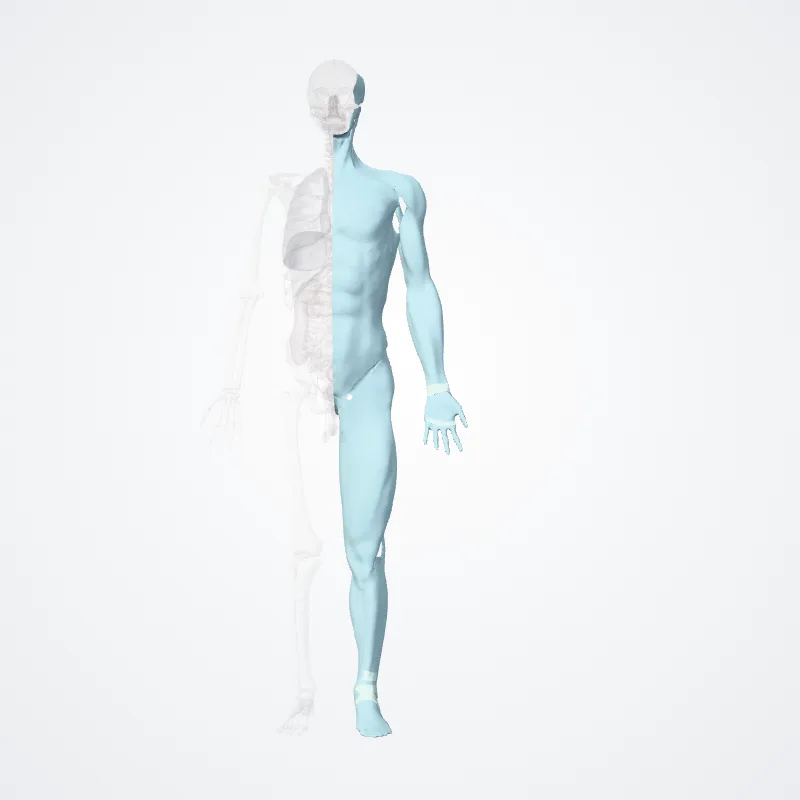
A fascia (plural fasciae; adjective fascial; from Latin: "band") is a band or sheet of connective tissue, primarily collagen, beneath the skin that attaches to, stabilizes, encloses, and separates muscles and other internal organs.
Fascia is classified by layer, as superficial fascia, deep fascia, and visceral or parietal fascia, or by its function and anatomical location.
Like ligaments, aponeuroses, and tendons, fascia is made up of fibrous connective tissue containing closely packed bundles of collagen fibers oriented in a wavy pattern parallel to the direction of pull.
Fascia is consequently flexible and able to resist great unidirectional tension forces until the wavy pattern of fibers has been straightened out by the pulling force.
These collagen fibers are produced by fibroblasts located within the fascia.Fasciae are similar to ligaments and tendons as they have collagen as their major component.
They differ in their location and function: ligaments join one bone to another bone, tendons join muscle to bone, and fasciae surround muscles and other structures.
Continue reading on Wikipedia →
Source: Wikipedia · Text licence: CC BY-SA 3.0 · This text comes from the source data and has not been reviewed by a person yet.
Parts
Names
- Latin
- Fasciae
- English
- Fasciae
- French
- Fascias
- Spanish
- Fascias musculares
- Portuguese
- Fáscia