Landmark · Nervous system & sense organs
Posterior semicircular canal
Canalis semicircularis posterior
- System
- Nervous system & sense organs
- Regions
- Head
- Side
- Right
- Landmark on
- Vestibule
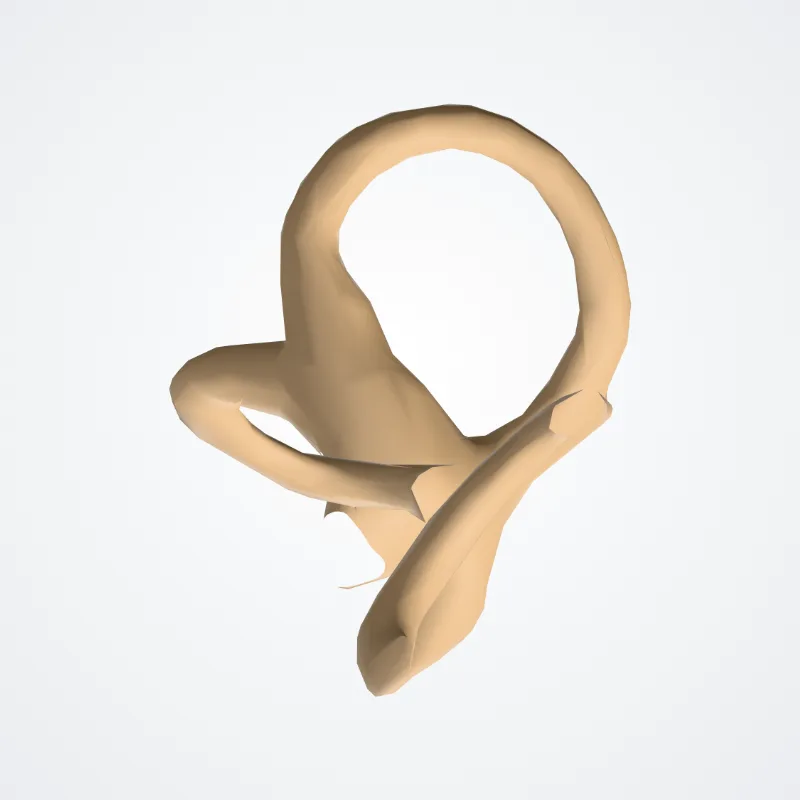
DescriptionUnreviewed
The posterior semicircular canal is a part of the vestibular system that detects rotation of the head around the antero-posterior (sagittal) axis, or in other words rotation in the coronal plane.
This occurs, for example, when one moves the head to touch the shoulders, or when doing a cartwheel.
It is directed superiorly, as per its nomenclature, and posteriorly, nearly parallel to the posterior surface of the petrous bone.
The vestibular aqueduct is immediately medial to it.
The posterior canal is part of the bony labyrinth and is used by the vestibular system to detect rotations of the head in the coronal plane.
It is the longest of the three canals, measuring from 18 to 22 mm (0.71 to 0.87 in).
Its lower or ampullated end opens into the lower and back part of the vestibule, its upper into the crus commune.
Source: Wikipedia · Text licence: CC BY-SA 3.0 · This text comes from the source data and has not been reviewed by a person yet.
Names
- Latin
- Canalis semicircularis posterior
- English
- Posterior semicircular canal
- French
- Canal semicirculaire postérieur
- Spanish
- Canal semicircular posterior
- Portuguese
- Canal semicircular posterior