Nervous system & sense organs
Radial nerve
Nervus radialis
- System
- Nervous system & sense organs
- Regions
- Upper limb
- Side
- Left and right
- Part of
- Branches of posterior cord of brachial plexus
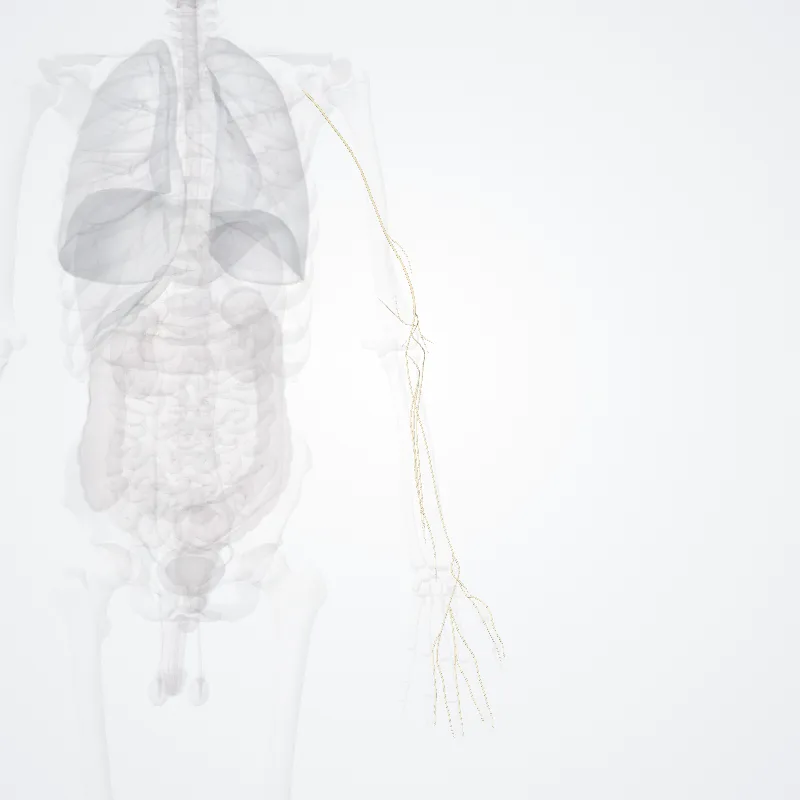
DescriptionUnreviewed
The radial nerve is a nerve in the human body that supplies the posterior portion of the upper limb.
It innervates the medial and lateral heads of the triceps brachii muscle of the arm, as well as all 12 muscles in the posterior osteofascial compartment of the forearm and the associated joints and overlying skin.
It originates from the brachial plexus, carrying fibers from the ventral roots of spinal nerves C5, C6, C7, C8 & T1.
The radial nerve and its branches provide motor innervation to the dorsal arm muscles (the triceps brachii and the anconeus) and the extrinsic extensors of the wrists and hands; it also provides cutaneous sensory innervation to most of the back of the hand, except for the back of the little finger and adjacent half of the ring finger (which are innervated by the ulnar nerve).
The radial nerve divides into a deep branch, which becomes the posterior interosseous nerve, and a superficial branch, which goes on to innervate the dorsum (back) of the hand.
Continue reading on Wikipedia →
Source: Wikipedia · Text licence: CC BY-SA 3.0 · This text comes from the source data and has not been reviewed by a person yet.
Parts
Names
- Latin
- Nervus radialis
- English
- Radial nerve
- French
- Nerf radial
- Spanish
- Nervio radial
- Portuguese
- Nervo radial