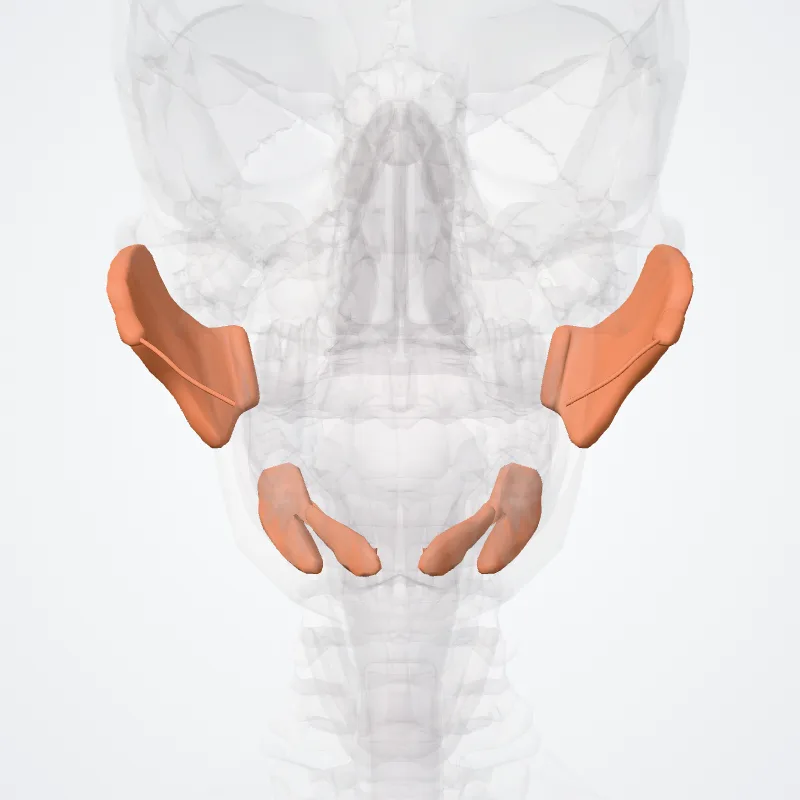
DescriptionUnreviewed
The salivary glands in mammals are exocrine glands that produce saliva through a system of ducts.
Humans have three paired major salivary glands (parotid, submandibular, and sublingual), as well as hundreds of minor salivary glands.
Salivary glands can be classified as serous, mucous, or seromucous (mixed).
In serous secretions, the main type of protein secreted is alpha-amylase, an enzyme that breaks down starch into maltose and glucose, whereas in mucous secretions, the main protein secreted is mucin, which acts as a lubricant.
In humans, between 0.5 and 1.5 l of saliva are produced every day.
The secretion of saliva (salivation) is mediated by parasympathetic stimulation; acetylcholine is the active neurotransmitter and binds to muscarinic receptors in the glands, leading to increased salivation.
The fourth pair of salivary glands, the tubarial glands discovered in 2020, are named for their location, being positioned in front and over the torus tubarius.
However, this finding from one study is yet to be confirmed.
Continue reading on Wikipedia →
Source: Wikipedia · Text licence: CC BY-SA 3.0 · This text comes from the source data and has not been reviewed by a person yet.
Parts
Names
- Latin
- Glandulae salivariae
- English
- Salivary glands
- French
- Glandes salivaires
- Spanish
- Glándulas salivales
- Portuguese
- Glândulas salivares