Nervous system & sense organs
Trigeminal nerve (V)
Nervus trigeminus (V)
- System
- Nervous system & sense organs
- Regions
- Head
- Side
- Left and right
- Part of
- Cranial nerves
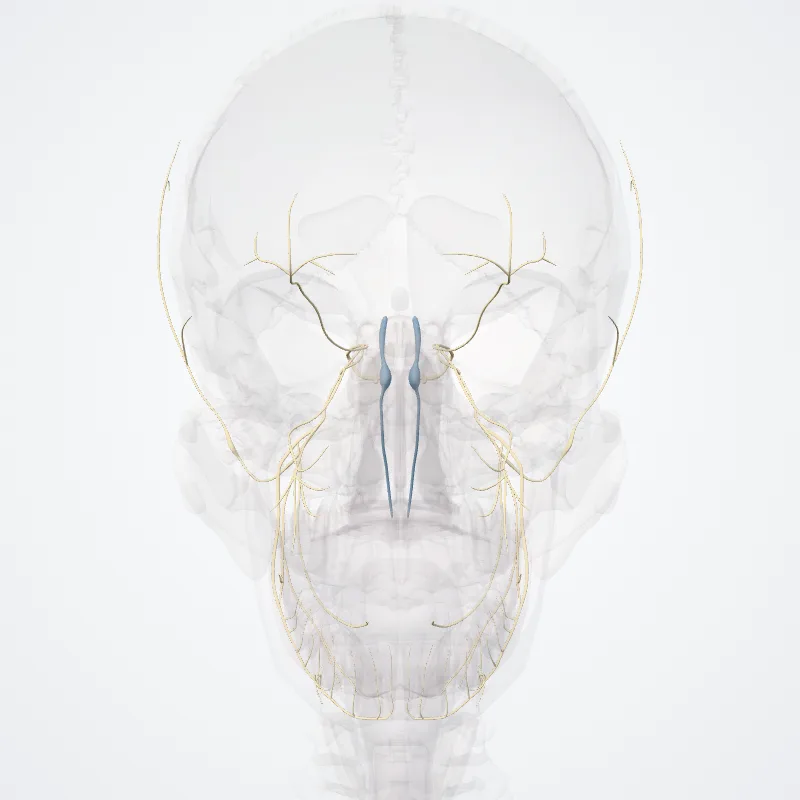
DescriptionUnreviewed
The trigeminal nerve (the fifth cranial nerve, or simply CN V) is a nerve responsible for sensation in the face and motor functions such as biting and chewing; it is the most complex of the cranial nerves.
Its name ("trigeminal" = tri-, or three, and - geminus, or twin: thrice-twinned) derives from each of the two nerves (one on each side of the pons) having three major branches: the ophthalmic nerve (V1), the maxillary nerve (V2), and the mandibular nerve (V3).
The ophthalmic and maxillary nerves are purely sensory, whereas the mandibular nerve supplies motor as well as sensory (or "cutaneous") functions.
Adding to the complexity of this nerve is that autonomic nerve fibers as well as special sensory fibers (taste) are contained within it.
The motor division of the trigeminal nerve derives from the basal plate of the embryonic pons, and the sensory division originates in the cranial neural crest.
Sensory information from the face and body is processed by parallel pathways in the central nervous system.
Continue reading on Wikipedia →
Source: Wikipedia · Text licence: CC BY-SA 3.0 · This text comes from the source data and has not been reviewed by a person yet.
Parts
Names
- Latin
- Nervus trigeminus (V)
- English
- Trigeminal nerve (V)
- French
- Nerf trijumeau (V)
- Spanish
- Nervio trigémino (V)
- Portuguese
- Nervo trigêmeo (V)