Landmark · Skin & body regions
Upper eyelid
Palpebra superior
- System
- Skin & body regions
- Regions
- Head
- Side
- Right
- Landmark on
- Orbital region
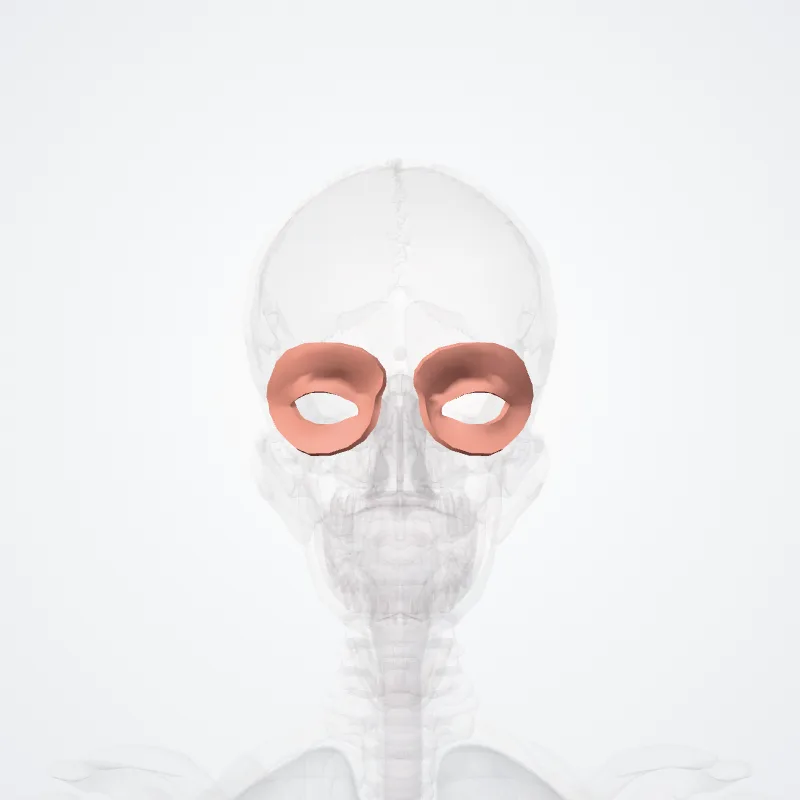
DescriptionUnreviewed
An eyelid is a thin fold of skin that covers and protects an eye.
The levator palpebrae superioris muscle retracts the eyelid, exposing the cornea to the outside, giving vision.
This can be either voluntarily or involuntarily.
The human eyelid features a row of eyelashes along the eyelid margin, which serve to heighten the protection of the eye from dust and foreign debris, as well as from perspiration.
"Palpebral" (and "blepharal") means relating to the eyelids.
Its key function is to regularly spread the tears and other secretions on the eye surface to keep it moist, since the cornea must be continuously moist.
They keep the eyes from drying out when asleep.
Moreover, the blink reflex protects the eye from foreign bodies.
The appearance of the human upper eyelid often varies between different populations.
The prevalence of an epicanthic fold covering the inner corner of the eye account for the majority of East Asian and Southeast Asian populations, and is also found in varying degrees among other populations.
Separately, but also similarly varying between populations, the crease of the remainder of the eyelid may form either a "single eyelid", a "double eyelid", or an intermediate form.
Eyelids can be found in other animals, some of which may have a third eyelid, or nictitating membrane.
A vestige of this in humans survives as the plica semilunaris.
Continue reading on Wikipedia →
Source: Wikipedia · Text licence: CC BY-SA 3.0 · This text comes from the source data and has not been reviewed by a person yet.
Names
- Latin
- Palpebra superior
- English
- Upper eyelid
- French
- Paupière supérieure
- Spanish
- Párpado superior
- Portuguese
- Pálpebra superior