Gruppe · Nervensystem und Sinnesorgane
Cerebellum
- System
- Nervensystem und Sinnesorgane
- Regionen
- Kopf
- Teil von
- Encephalon
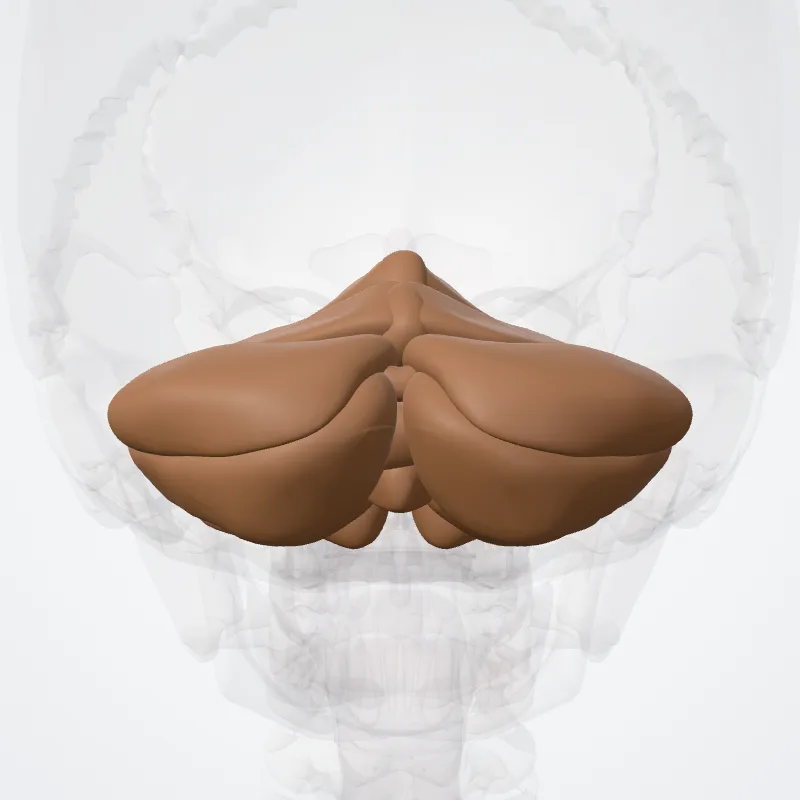
BeschreibungUngeprüft
Beschreibungen gibt es nur auf Englisch.
The cerebellum (Latin for "little brain") is a major feature of the hindbrain of all vertebrates.
Although usually smaller than the cerebrum, in some animals such as the mormyrid fishes it may be as large as or even larger.
In humans, the cerebellum plays an important role in motor control.
It may also be involved in some cognitive functions such as attention and language as well as emotional control such as regulating fear and pleasure responses, but its movement-related functions are the most solidly established.
The human cerebellum does not initiate movement, but contributes to coordination, precision, and accurate timing: it receives input from sensory systems of the spinal cord and from other parts of the brain, and integrates these inputs to fine-tune motor activity.
Cerebellar damage produces disorders in fine movement, equilibrium, posture, and motor learning in humans.Anatomically, the human cerebellum has the appearance of a separate structure attached to the bottom of the brain, tucked underneath the cerebral hemispheres.
Its cortical surface is covered with finely spaced parallel grooves, in striking contrast to the broad irregular convolutions of the cerebral cortex.
These parallel grooves conceal the fact that the cerebellar cortex is actually a continuous thin layer of tissue tightly folded in the style of an accordion.
Within this thin layer are several types of neurons with a highly regular arrangement, the most important being Purkinje cells and granule cells.
This complex neural organization gives rise to a massive signal-processing capability, but almost all of the output from the cerebellar cortex passes through a set of small deep nuclei lying in the white matter interior of the cerebellum.In addition to its direct role in motor control, the cerebellum is necessary for several types of motor learning, most notably learning to adjust to changes in sensorimotor relationships.
Quelle: Wikipedia · Textlizenz: CC BY-SA 3.0 · Dieser Text stammt aus den Quelldaten und wurde noch nicht von einer Person geprüft.
Bestandteile
- Ala lobuli centralis
- Culmen
- Declive
- Flocculus
- Folium vermis
- Lingula cerebelli
- Lobulus biventer
- Lobulus centralis vermis
- Lobulus gracilis
- Lobulus quadrangularis anterior
- Lobulus quadrangularis posterior
- Lobulus semilunaris inferior
- Lobulus semilunaris superior
- Nodulus vermis
- Pedunculi cerebellares
- Pedunculus cerebellaris superior
- Pedunculus flocculi
- Pyramis vermis
- Tonsilla cerebelli
- Tuber vermis
- Uvula vermis
Namen
- Latein
- Cerebellum
- Englisch
- Cerebellum
- Französisch
- Cervelet
- Spanisch
- Cerebelo
- Portugiesisch
- Cerebelo