Gruppe · Nervensystem und Sinnesorgane
Trucus encephali
Brainstem
- System
- Nervensystem und Sinnesorgane
- Regionen
- Kopf
- Teil von
- Encephalon
BeschreibungUngeprüft
Beschreibungen gibt es nur auf Englisch.
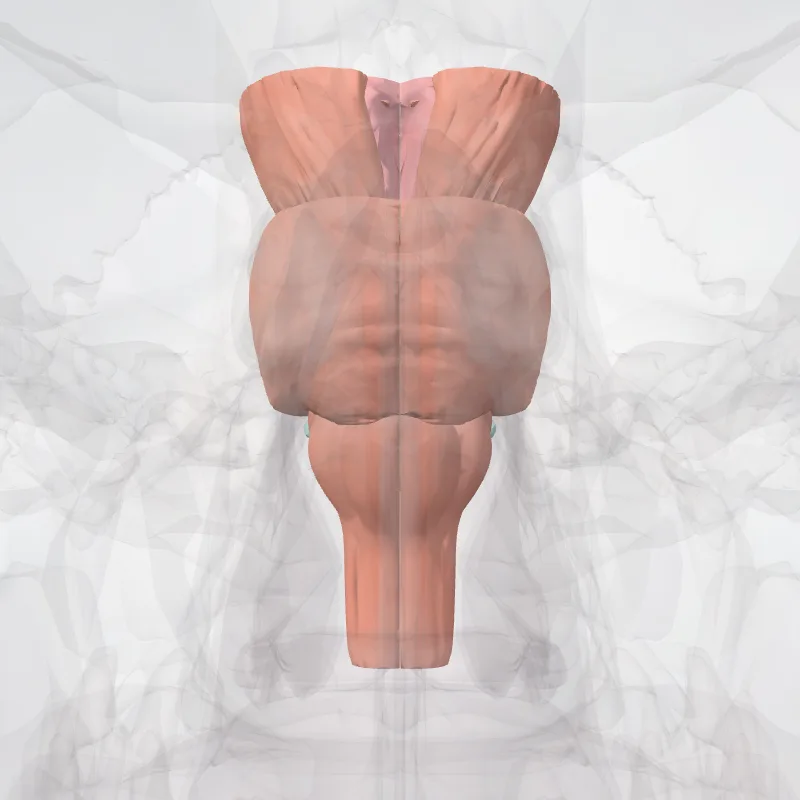
The brainstem (or brain stem) is the posterior stalk-like part of the brain that connects the cerebrum with the spinal cord.
In the human brain the brainstem is composed of the midbrain, the pons, and the medulla oblongata.
The midbrain is continuous with the thalamus of the diencephalon through the tentorial notch, and sometimes the diencephalon is included in the brainstem.
The brainstem is very small, making up around only 2.6 percent of the brain's total weight.
It has the critical roles of regulating cardiac, and respiratory function, helping to control heart rate and breathing rate.
It also provides the main motor and sensory nerve supply to the face and neck via the cranial nerves.
Ten pairs of cranial nerves come from the brainstem.
Other roles include the regulation of the central nervous system and the body's sleep cycle.
It is also of prime importance in the conveyance of motor and sensory pathways from the rest of the brain to the body, and from the body back to the brain.
These pathways include the corticospinal tract (motor function), the dorsal column-medial lemniscus pathway (fine touch, vibration sensation, and proprioception), and the spinothalamic tract (pain, temperature, itch, and crude touch).
Quelle: Wikipedia · Textlizenz: CC BY-SA 3.0 · Dieser Text stammt aus den Quelldaten und wurde noch nicht von einer Person geprüft.
Bestandteile
Namen
- Latein
- Trucus encephali
- Englisch
- Brainstem
- Französisch
- Tronc cérébral
- Spanisch
- Tronco encefálico
- Portugiesisch
- Tronco cerebral