Nervensystem und Sinnesorgane
Sclera
- System
- Nervensystem und Sinnesorgane
- Regionen
- Kopf
- Seite
- Links und rechts
- Teil von
- Bulbus oculi
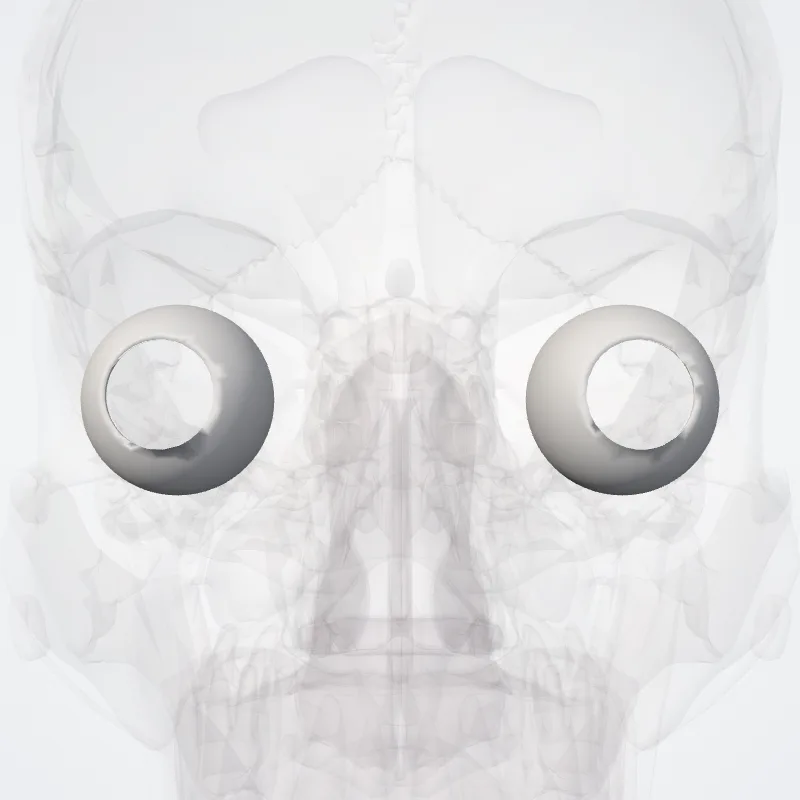
BeschreibungUngeprüft
Beschreibungen gibt es nur auf Englisch.
The sclera, also known as the white of the eye or, in older literature, as the tunica albuginea oculi, is the opaque, fibrous, protective, outer layer of the human eye containing mainly collagen and some crucial elastic fiber.
In humans, and some other vertebrates, the whole sclera is white, contrasting with the coloured iris, but in most mammals, the visible part of the sclera matches the colour of the iris, so the white part does not normally show while other vertebrates have distinct colors for both of them.
In the development of the embryo, the sclera is derived from the neural crest.
In children, it is thinner and shows some of the underlying pigment, appearing slightly blue.
In the elderly, fatty deposits on the sclera can make it appear slightly yellow.
People with dark skin can have naturally darkened sclerae, the result of melanin pigmentation.The human eye is relatively rare for having a pale sclera (relative to the iris).
This makes it easier for one individual to identify where another individual is looking, and the cooperative eye hypothesis suggests this has evolved as a method of nonverbal communication.
Quelle: Wikipedia · Textlizenz: CC BY-SA 3.0 · Dieser Text stammt aus den Quelldaten und wurde noch nicht von einer Person geprüft.
Landmarken
Namen
- Latein
- Sclera
- Englisch
- Sclera
- Französisch
- Sclère
- Spanisch
- Esclera
- Portugiesisch
- Esclera