Skeletal system
Femur
Os femoris
- System
- Skeletal system
- Regions
- Lower limb
- Side
- Left and right
- Part of
- Bones of free part of lower limb
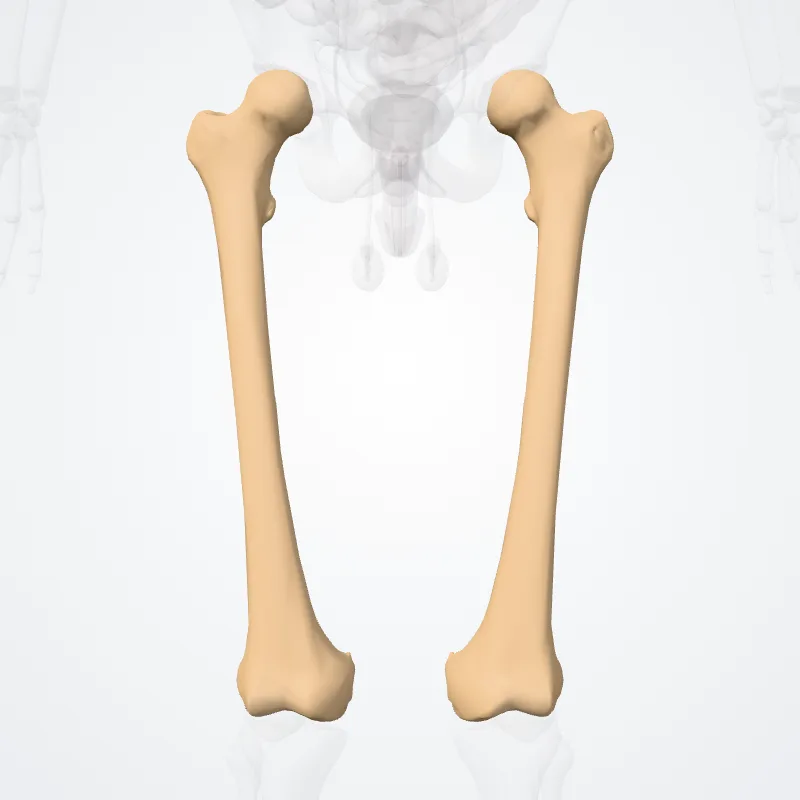
DescriptionUnreviewed
The femur (pl. femurs or femora), or thigh bone, is the proximal bone of the hindlimb in tetrapod vertebrates.
The head of the femur articulates with the acetabulum in the pelvic bone forming the hip joint, while the distal part of the femur articulates with the tibia (shinbone) and patella (kneecap), forming the knee joint.
By most measures the two (left and right) femurs are the strongest bones of the body, and in humans, the largest and thickest.
Continue reading on Wikipedia →
Source: Wikipedia · Text licence: CC BY-SA 3.0 · This text comes from the source data and has not been reviewed by a person yet.
Muscle attachments
Muscles that arise here
- Lateral head of gastrocnemius
- Medial head of gastrocnemius
- Plantaris muscle
- Popliteus muscle
- Vastus intermedius muscle
- Vastus lateralis muscle
- Vastus medialis muscle
Muscles that insert here
Landmarks
- (Third trochanter)
- Adductor tubercle
- Body of femur
- Fovea for ligament of head of femur
- Gluteal tuberosity
- Greater trochanter
- Groove for popliteus muscle
- Head of femur
- Intercondylar fossa
- Intercondylar line
- Intertrochanteric crest
- Intertrochanteric line
- Lateral condyle of femur
- Lateral epicondyle of femur
- Lateral lip of linea aspera
- Lateral supracondylar line
- Lesser trochanter
- Linea aspera
- Medial condyle of femur
- Medial epicondyle of femur
- Medial lip of linea aspera
- Medial supracondylar line
- Neck of femur
- Patellar surface of femur
- Pectineal line of femur
- Popliteal surface of femur
- Quadrate tubercle
- Trochanteric fossa
Names
- Latin
- Os femoris
- English
- Femur
- French
- Fémur
- Spanish
- Hueso Fémur
- Portuguese
- Fêmur