Visceral systems
Kidney
Ren
- System
- Visceral systems
- Regions
- Trunk, Abdomen
- Side
- Left and right
- Part of
- Urinary system
DescriptionUnreviewed
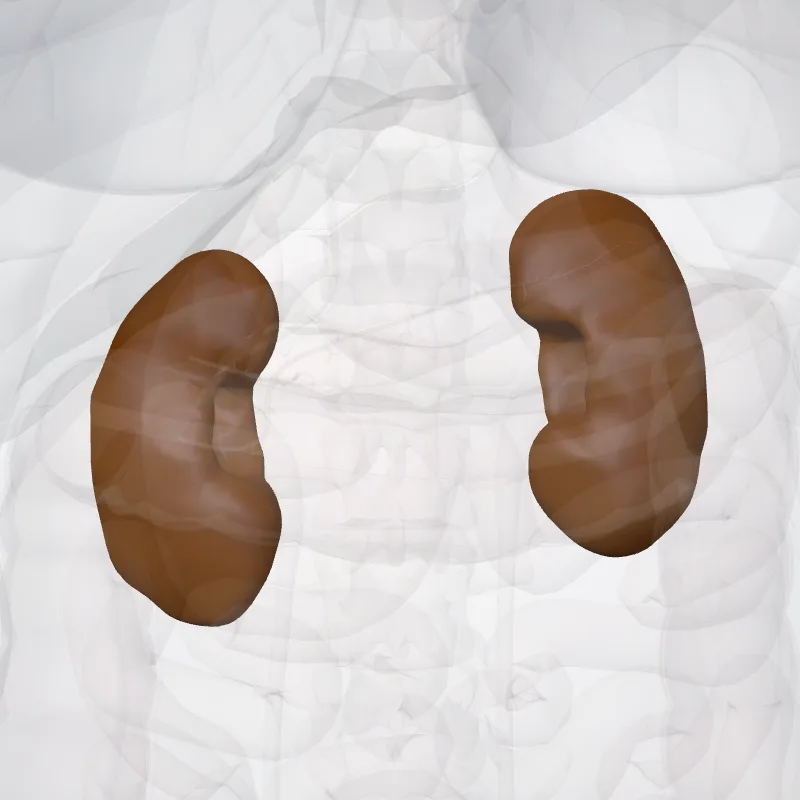
The kidneys are two reddish-brown bean-shaped organs found in vertebrates.
They are located on the left and right in the retroperitoneal space, and in adult humans are about 12 centimetres (4+1⁄2 inches) in length.
They receive blood from the paired renal arteries; blood exits into the paired renal veins.
Each kidney is attached to a ureter, a tube that carries excreted urine to the bladder.
The kidney participates in the control of the volume of various body fluids, fluid osmolality, acid–base balance, various electrolyte concentrations, and removal of toxins.
Filtration occurs in the glomerulus: one-fifth of the blood volume that enters the kidneys is filtered.
Examples of substances reabsorbed are solute-free water, sodium, bicarbonate, glucose, and amino acids.
Examples of substances secreted are hydrogen, ammonium, potassium and uric acid.
The kidneys also carry out functions independent of the nephron.
For example, they convert a precursor of vitamin D to its active form, calcitriol; and synthesize the hormones erythropoietin and renin.
The nephron is the structural and functional unit of the kidney.
Each adult human kidney contains around 1 million nephrons, while a mouse kidney contains only about 12,500 nephrons.
Procedures used in the management of kidney disease include chemical and microscopic examination of the urine (urinalysis), measurement of kidney function by calculating the estimated glomerular filtration rate (eGFR) using the serum creatinine; and kidney biopsy and CT scan to evaluate for abnormal anatomy.
Continue reading on Wikipedia →
Source: Wikipedia · Text licence: CC BY-SA 3.0 · This text comes from the source data and has not been reviewed by a person yet.
Landmarks
Names
- Latin
- Ren
- English
- Kidney
- French
- Rein
- Spanish
- Riñón
- Portuguese
- Rim