Skeletal system
Mandible
Mandibula
- System
- Skeletal system
- Regions
- Head
- Part of
- Extracranial bones of head
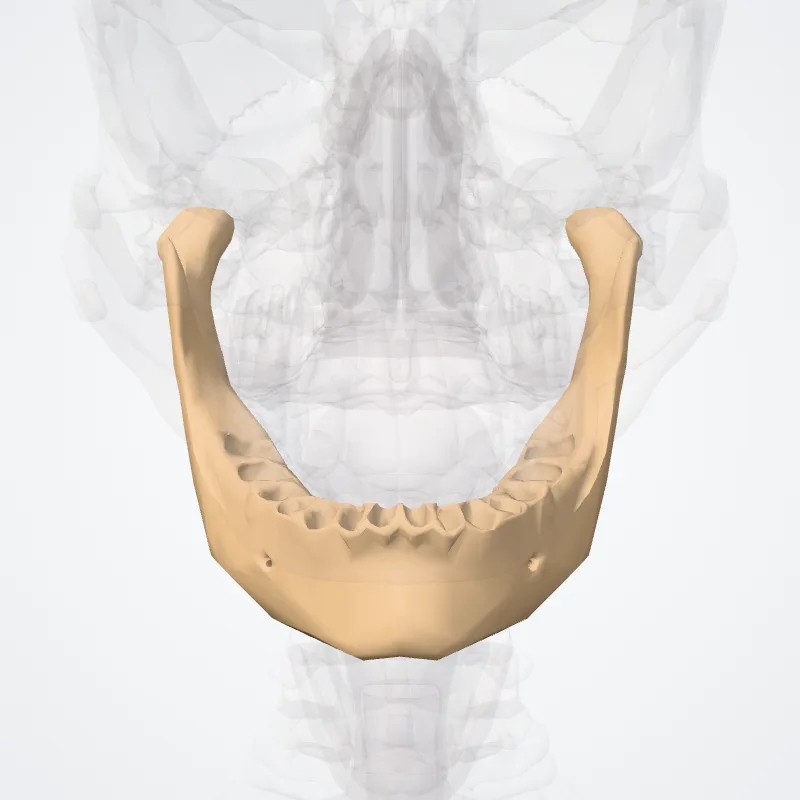
DescriptionUnreviewed
In anatomy, the mandible, lower jaw or jawbone is the largest, strongest and lowest bone in the human facial skeleton.
It forms the lower jaw and holds the lower teeth in place.
The mandible sits beneath the maxilla.
It is the only movable bone of the skull (discounting the ossicles of the middle ear).
It is connected to the temporal bones by the temporomandibular joints.
The bone is formed in the fetus from a fusion of the left and right mandibular prominences, and the point where these sides join, the mandibular symphysis, is still visible as a faint ridge in the midline.
Like other symphyses in the body, this is a midline articulation where the bones are joined by fibrocartilage, but this articulation fuses together in early childhood.
The word "mandible" derives from the Latin word mandibula, "jawbone" (literally "one used for chewing"), from mandere "to chew" and -bula (instrumental suffix).
Continue reading on Wikipedia →
Source: Wikipedia · Text licence: CC BY-SA 3.0 · This text comes from the source data and has not been reviewed by a person yet.
Muscle attachments
Muscles that arise here
- Bucinator
- Depressor anguli oris
- Depressor labii inferioris
- Geniohyoid muscle
- Mentalis muscle
- Mylohyoid muscle
- Orbicularis oris muscle
Muscles that insert here
Landmarks
Names
- Latin
- Mandibula
- English
- Mandible
- French
- Mandibule
- Spanish
- Mandíbula
- Portuguese
- Mandíbula