Skeletal system
Parietal bone
Os parietale
- System
- Skeletal system
- Regions
- Head
- Side
- Left and right
- Part of
- Bones of cranium
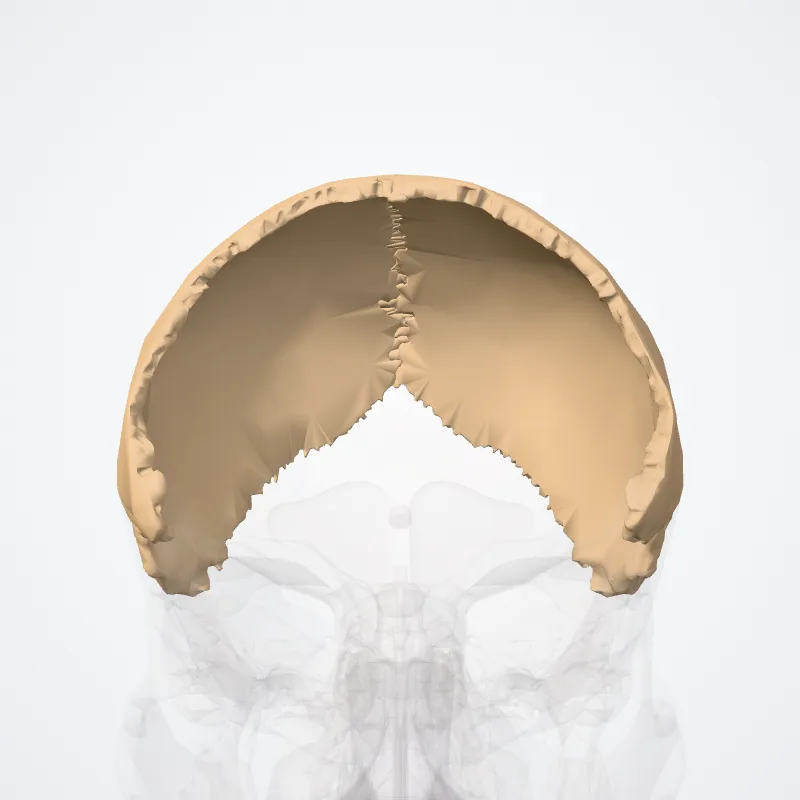
DescriptionUnreviewed
The parietal bones are two bones in the skull which, when joined together at a fibrous joint, form the sides and roof of the cranium.
In humans, each bone is roughly quadrilateral in form, and has two surfaces, four borders, and four angles.
It is named from the Latin paries (-ietis), wall.
EXTERNAL SURFACE:
The external surface [Fig. 1] is convex, smooth, and marked near the center by an eminence, the parietal eminence (tuber parietale), which indicates the point where ossification commenced.
Crossing the middle of the bone in an arched direction are two curved lines, the superior and inferior temporal lines; the former gives attachment to the temporal fascia, and the latter indicates the upper limit of the muscular origin of the temporal muscle.
Above these lines the bone is covered by a tough layer of fibrous tissue – the epicranial aponeurosis; below them it forms part of the temporal fossa, and affords attachment to the temporal muscle.
At the back part and close to the upper or sagittal border is the parietal foramen which transmits a vein to the superior sagittal sinus, and sometimes a small branch of the occipital artery; it is not constantly present, and its size varies considerably.
INTERNAL SURFACE:
The internal surface is concave; it presents depressions corresponding to the cerebral convolutions, and numerous furrows (grooves) for the ramifications of the middle meningeal artery; the latter run upward and backward from the sphenoidal angle, and from the central and posterior part of the squamous border.
Continue reading on Wikipedia →
Source: Wikipedia · Text licence: CC BY-SA 3.0 · This text comes from the source data and has not been reviewed by a person yet.
Muscle attachments
Muscles that arise here
Landmarks
- External surface of parietal bone
- Frontal angle of parietal bone
- Frontal border of parietal bone
- Groove for middle meningeal artery
- Inferior temporal line
- Internal surface of parietal bone
- Mastoid angle of parietal bone
- Occipital angle of parietal bone
- Occipital border of parietal bone
- Parietal eminence
- Parietal foramen
- Sagittal border of parietal bone
- Sphenoidal angle of parietal bone
- Squamosal border of parietal bone
- Superior temporal line
Names
- Latin
- Os parietale
- English
- Parietal bone
- French
- Os pariétal
- Spanish
- Hueso parietal
- Portuguese
- Osso parietal