Landmark · Skeletal system
Vertebra
- System
- Skeletal system
- Regions
- Trunk, Abdomen, Back
- Landmark on
- Vertebra L3
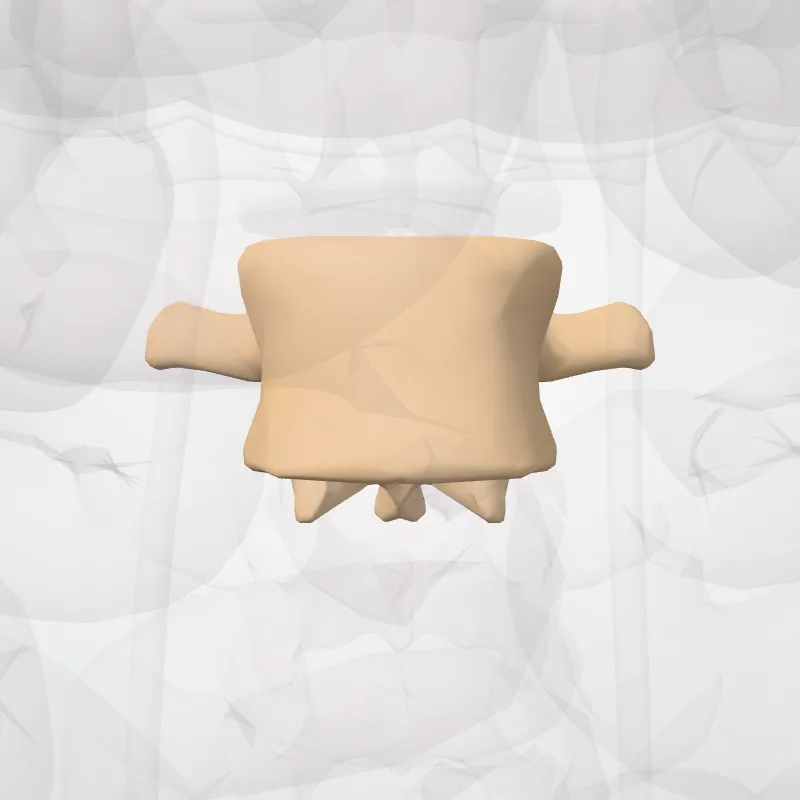
DescriptionUnreviewed
The spinal column, characteristic of each vertebrate species, is a moderately flexible series of vertebrae (singular vertebra), each constituting a characteristic irregular bone whose complex structure is composed primarily of bone, and secondarily of hyaline cartilage.
They show variation in the proportion contributed by these two tissue types; such variations correlate on one hand with the cerebral/caudal rank (i.e., location within the backbone), and on the other with phylogenetic differences among the vertebrate taxa.
The basic configuration of a vertebra varies, but the bone is its body, with the central part of the body constituting the centrum.
The upper (closer to) and lower (further from), respectively, the cranium and its central nervous system surfaces of the vertebra body support attachment to the intervertebral discs.
The posterior part of a vertebra forms a vertebral arch (in eleven parts, consisting of two pedicles (pedicle of vertebral arch) two laminae, and seven processes.
The laminae give attachment to the ligamenta flava, which are ligaments of the spine.
There are vertebral notches, each constituted by the shape of the pedicles, which form the intervertebral foramina when vertebrae articulate.
These foramina are the entry and exit conduits accommodating the spinal nerves.
The body of the vertebra, and it's vertebral arch, form the vertebral foramen, which is the larger, stable and central opening: this accommodates the spinal canal, and encloses and protects the spinal cord.
Continue reading on Wikipedia →
Source: Wikipedia · Text licence: CC BY-SA 3.0 · This text comes from the source data and has not been reviewed by a person yet.
Names
- Latin
- Vertebra
- English
- Vertebra
- French
- Vertèbre
- Spanish
- Vértebra
- Portuguese
- Vértebra